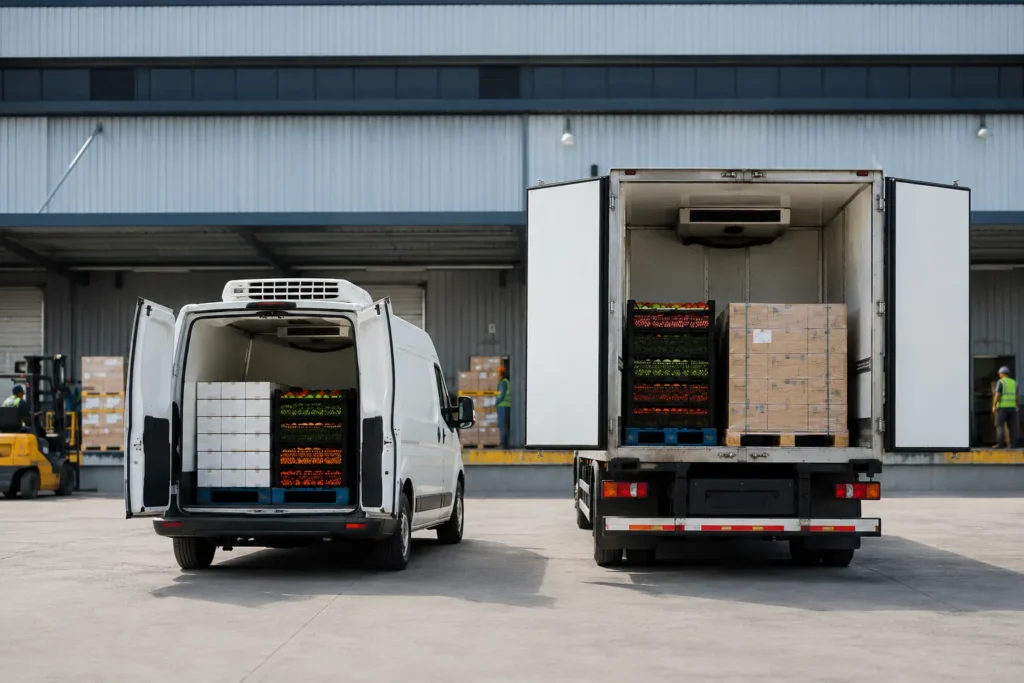
One of the most common questions we get from FMCG distributors, caterers, and retail suppliers in the UAE is whether they need a chiller van or a freezer truck. The two vehicle types look similar from the outside, but they are built for fundamentally different jobs, and choosing wrong means either paying for capacity you don’t need or, worse, putting temperature-sensitive cargo into a vehicle that cannot legally or physically hold the range it requires.
This guide breaks down the real difference between a chiller van and a freezer truck, when each one is the right call, and how to size the vehicle correctly for your route and cargo volume.
Chiller Van vs Freezer Truck: The Core Difference
A chiller van maintains a positive temperature range, typically 0°C to +8°C, and is built for cargo that needs to stay cold but not frozen. A freezer truck maintains a sub-zero range, typically -18°C to -25°C, and is built for cargo that must remain solidly frozen throughout transit. The refrigeration units, insulation specifications, and even the door seal designs differ between the two, because holding a stable sub-zero temperature in UAE ambient heat is a materially harder engineering problem than holding a positive chilled range.
| Feature | Chiller Van | Freezer Truck |
|---|---|---|
| Temperature range | 0°C to +8°C | -18°C to -25°C |
| Typical cargo | Dairy, produce, pharmaceuticals, bakery, catering | Frozen seafood, frozen meat, ice cream, deep-frozen FMCG |
| Refrigeration unit demand | Moderate | High, continuous compressor load |
| Typical tonnage | 1-ton to 3-ton for urban routes | 3-ton to 10-ton for bulk and wholesale routes |
| Legal margin for error | 2 to 5 degrees depending on category | Wider, but excursions above -18°C risk product texture and safety |
Using a chiller van for frozen cargo is not a viable workaround. The refrigeration unit is not sized to pull cargo down to -18°C, and even if it could reach that range briefly, it could not sustain it under UAE ambient load across a full delivery shift. Conversely, using a freezer truck for chilled-only cargo like dairy or produce works physically, but it is an expensive and inefficient choice, since you are paying for sub-zero refrigeration capacity you do not need.
When to Choose a Chiller Van
A chiller van is the right choice for dairy distribution, fresh produce, bakery and patisserie delivery, catering logistics, and pharmaceutical cargo in the +2°C to +8°C range. It is also the more economical and maneuverable option for dense urban multi-drop routes in Dubai and Abu Dhabi, where smaller vehicles navigate loading zones and retail back entrances more easily than a full-size truck.
For catering operations specifically, a high-roof chiller van configuration is worth requesting. The additional internal standing height accommodates rolling bakery racks and tiered catering trays without requiring items to be laid flat, which matters for delicate pastries, cakes, and plated items being moved to event venues.
When to Choose a Freezer Truck
A freezer truck is the correct choice for frozen seafood, frozen meat and poultry, ice cream and frozen desserts, and any FMCG product requiring sustained sub-zero storage. This is also the vehicle class for bulk wholesale and inter-emirate transfers, where cargo volume and route distance make a larger, higher-capacity vehicle more cost-effective per unit of cargo moved than running multiple smaller vans.
For deep-frozen pharmaceutical cargo, such as certain biologics and reagents requiring -15°C to -25°C, a validated freezer truck with continuous temperature data logging is required, not a standard chiller configuration. This is a distinct requirement from the general +2°C to +8°C pharmaceutical range covered by chiller vans, and the two should not be conflated when specifying a vehicle for a mixed pharma distribution contract.
Tonnage and Vehicle Size Guide
Getting the tonnage right avoids two common and costly mistakes: under-sizing, which forces multiple trips or leaves cargo exposed to ambient heat during a second loading cycle, and over-sizing, which means paying for unused capacity and, in dense urban zones, struggling with vehicle access and parking.
| Tonnage | Best For | Typical Use Case |
|---|---|---|
| 1-ton van | Small urban retail and pharmacy runs | Daily deliveries to individual stores, clinics, or restaurants |
| 1.5-ton van | Medium urban multi-drop routes | Catering, small-chain retail supply, bakery distribution |
| 3-ton truck | Wholesale and mid-volume distribution | Supermarket supply runs, restaurant group distribution |
| 7-ton truck | Bulk regional distribution | Warehouse-to-warehouse transfers, large event catering |
| 10-ton truck | Large-scale wholesale and inter-emirate transport | Port and airport pickups, cross-emirate bulk freight |
As a general rule, it is more cost-effective to run one correctly sized vehicle at 70 to 85% capacity than two under-loaded smaller vehicles covering the same route. If your delivery volume fluctuates significantly by day or season, discuss a flexible daily rental arrangement rather than committing to a single tonnage on a long-term contract.
Renting vs Buying: A Quick ROI Comparison
Owning a refrigerated fleet carries hidden costs that are easy to underestimate: refrigeration unit maintenance and eventual replacement, ASATEEL or SIRA GPS subscription fees, DM Card and ADAFSA FWD renewal and inspection costs, insurance, and depreciation on a vehicle class that works harder and wears faster than standard commercial vehicles due to constant compressor load in UAE heat. For businesses with variable or seasonal volume, such as catering companies or FMCG distributors with promotional spikes, renting converts these fixed costs into a predictable daily or monthly operating expense and removes the maintenance burden entirely.
Making the Right Choice for Your Business
Before booking a vehicle, answer these questions to land on the right specification. What is the actual required temperature range of your cargo, not just “cold” or “frozen” but the specific band? What is your typical load volume per run, and does it vary by day of week or season? How many stops does a typical route include, and how much door-open time does that imply? Are you moving a single cargo category, or do you need segregation for mixed loads?
At Ghabt Al Manchu Transport L.L.C, we operate both chiller van rental and freezer truck rental fleets across all seven UAE emirates, with tonnage options from 1-ton urban vans to 10-ton bulk freezer trucks. Every vehicle carries DM Card certification, ADAFSA FWD certification, and ASATEEL registration, and we have been matching UAE businesses to the right refrigerated vehicle since 2011.
Fleet options start at AED 350 per day for a 1-ton van, AED 400 per day for a 1.5-ton van, AED 600 per day for a 3-ton truck, AED 700 per day for a 7-ton truck, and AED 800 per day for a 10-ton truck, with daily and monthly rates available depending on your volume.
Not sure which vehicle fits your route and cargo? Contact us at +971 54 7171 345 and we will help you specify the right chiller van or freezer truck for your operation.